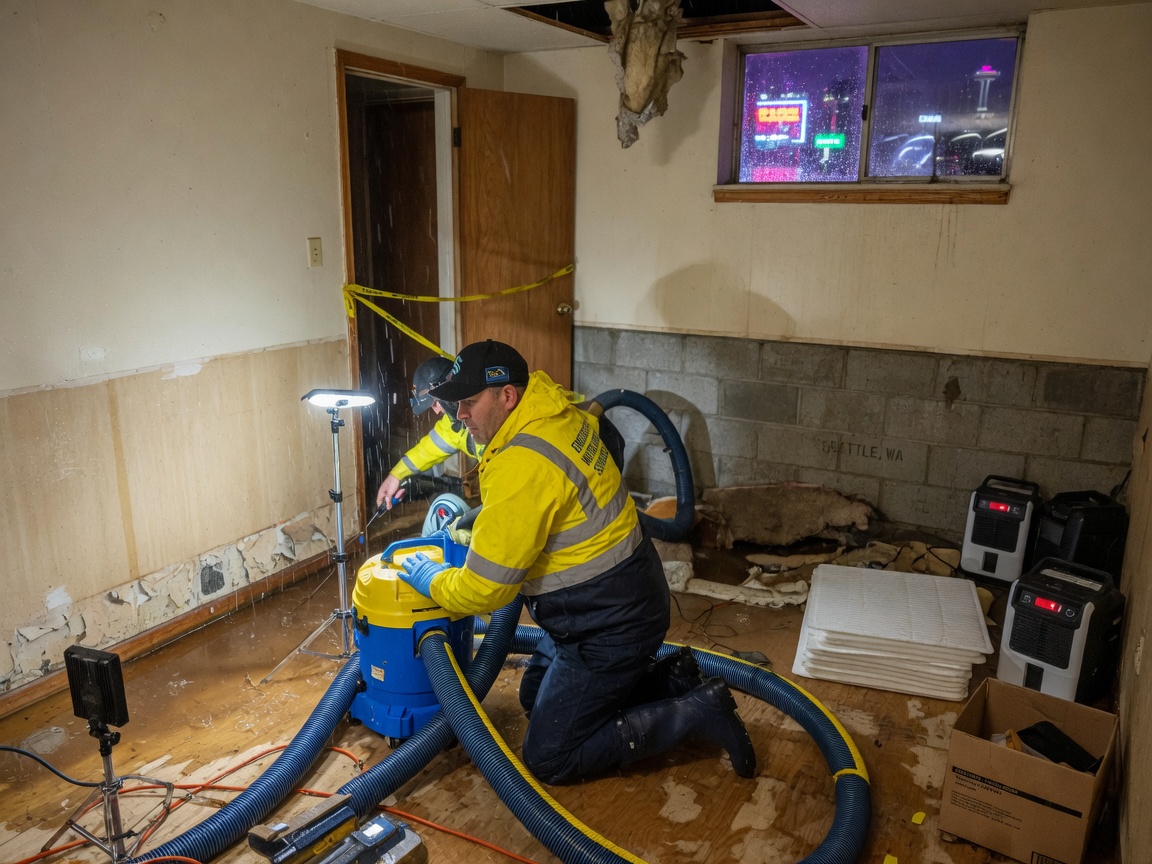
Seattle's older housing stock in neighborhoods like Queen Anne, Fremont, and Capitol Hill often features balloon-framed walls and knob-and-tube wiring that trap water behind plaster and lathe. Wet winters with frequent overcast skies keep soil saturated around foundations in Ballard and West Seattle, allowing moisture to wick upward through crawl spaces and create hidden mold colonies within 48 hours. Technicians must open walls at multiple elevations and use moisture meters calibrated for Pacific Northwest wood species to locate every pocket before rebuilding begins.
King County permitting rules require documentation of moisture levels below 15 percent before any new drywall or flooring can be installed after a flood event. In Belltown high-rises and University District apartments, shared plumbing stacks mean a leak on the tenth floor can affect units three floors below, requiring coordination with building management and temporary relocation of tenants. Dry summers reduce ambient humidity, which speeds drying but can cause wood framing to shrink and crack if dehumidifiers are removed too soon.
Terrain around Discovery Park and along Elliott Bay creates drainage challenges where runoff pools against south-facing walls during heavy winter rains. Restoration crews frequently encounter older cast-iron drain lines that have corroded from decades of standing water, turning a simple extraction job into a full pipe replacement coordinated with licensed plumbers. Homeowners in these areas learn to request written moisture mapping reports before any cosmetic repairs start.
Technician insight
In Seattle the thing that catches most people out with Emergency Water Damage Services is how quickly water travels behind the plaster in 1920s balloon-framed houses in Queen Anne and Capitol Hill; once it reaches the subfloor it soaks the soil under the foundation and you have to open the wall from the outside to stop it.
Queen Anne Victorian Leak
Water from a second-floor bathroom traveled down balloon-framed walls into the dining room below. Infrared scanning revealed moisture extending four feet into the subfloor joists. Crews extracted water, opened the exterior wall to dry the cavity, and ran equipment for five days until readings stabilized. Homeowner avoided full floor replacement after verification.
Emergency Water Damage Services Services We Offer
✓Burst Pipe Water Extraction
Immediate removal of standing water from kitchens and bathrooms in older Seattle homes where galvanized lines commonly fail during cold snaps.
✓Ceiling Leak Containment
Rapid isolation and drying of water that travels through multi-story balloon framing common in Capitol Hill and Queen Anne Victorians.
✓Sewage Backup Remediation
Safe extraction and disinfection of contaminated water from King County sewer lines backing up into basements during heavy winter rains.
✓Appliance Leak Drying
Targeted moisture removal behind refrigerators, washers, and water heaters in compact Belltown and Fremont units where leaks reach subfloors quickly.
✓Hidden Moisture Mapping
Infrared and probe readings to locate water trapped inside walls and under hardwood floors in West Seattle and University District homes.
Emergency Water Damage Services Cost in Seattle, WA
| Service | Typical Range | What Affects It |
|---|---|---|
| Initial Assessment And Extraction | $350–$750 | Higher when multiple floors or crawl spaces are involved |
| Equipment Rental Per Day | $150–$300 | Includes air movers, dehumidifiers, and moisture meters |
| Hidden Moisture Mapping | $200–$450 | Required in balloon-framed homes common in Capitol Hill and Fremont |
| Sewage Containment And Disposal | $600–$1,200 | Varies with volume and King County disposal fees |
Ranges are typical for Seattle, WA and confirmed with an exact written quote before any work starts.
How it works
- 1
On-Site Assessment
Technician arrives at the Seattle address, documents visible water paths, and maps affected rooms using moisture meters.
- 2
Water Removal
Pumps and extractors pull standing water while protecting adjacent finishes in older plaster walls.
- 3
Drying And Monitoring
Air movers and dehumidifiers run until readings drop below 15 percent, with daily checks logged for King County records.
- 4
Final Verification
Second moisture survey confirms all cavities are dry before any reconstruction begins.
Pricing
Cost depends on square footage affected, number of affected levels, and whether older cast-iron lines require replacement.