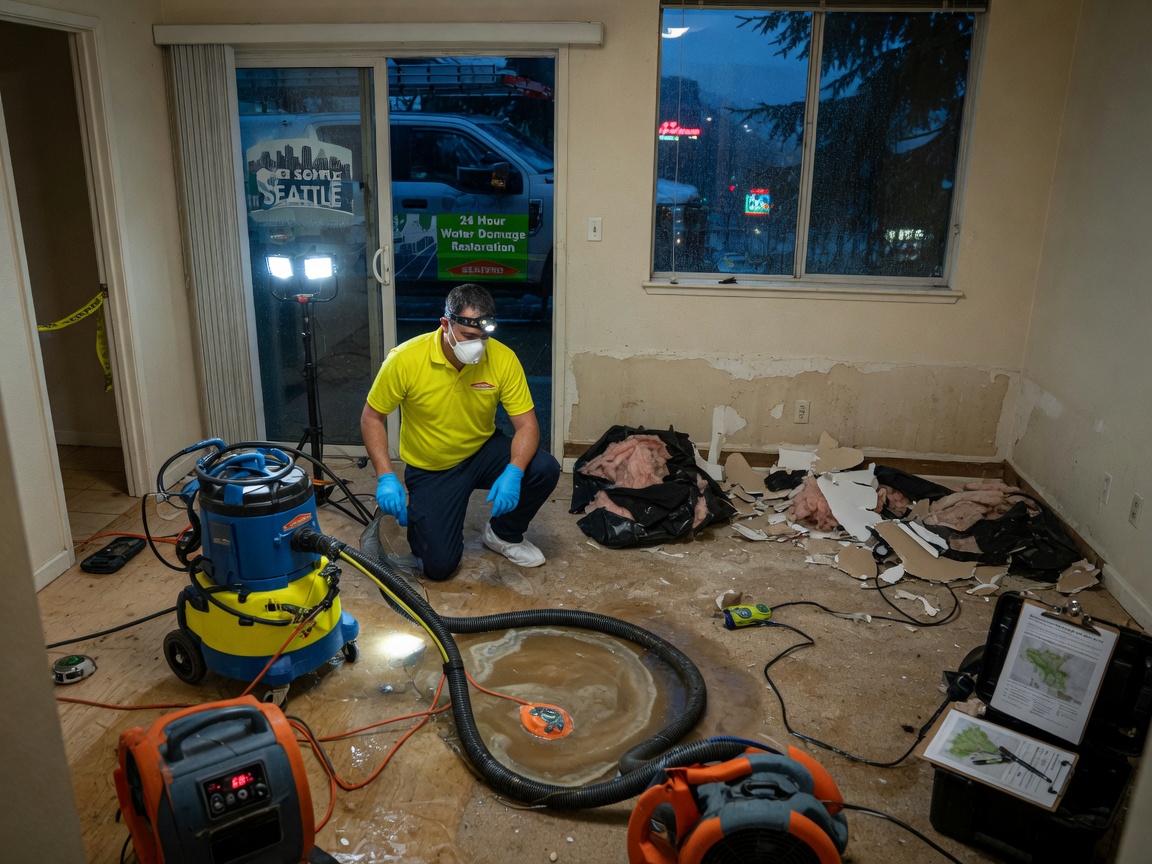
Seattle's older housing stock in neighborhoods like Queen Anne and Fremont often features balloon framing and knob-and-tube wiring that complicates drying after a leak. Wet winters bring repeated saturation to basements and crawl spaces, especially on sloped lots near Discovery Park where drainage is poor. Technicians must pull carpet padding quickly and use moisture meters on plaster lath walls to prevent hidden mold growth during the frequent overcast days that slow natural evaporation.
In Capitol Hill and Belltown multi-unit buildings, water from upper floors travels through shared walls and can affect units below within hours. Extraction equipment must be staged in tight stairwells while containing dust from older plaster. Technicians coordinate with property managers to isolate HVAC zones so spores do not spread to unaffected floors during the dry-out phase.
West Seattle and University District homes built on clay soils hold moisture longer after heavy rain, requiring longer dehumidifier run times than homes on sandier ground near Ballard. Crews document moisture readings at multiple depths in subfloors before declaring a structure dry to satisfy King County permitting notes on renovation work.
When a main line break occurs near Pike Place Market or Seattle Center, traffic and limited parking force smaller equipment loads and multiple trips. Technicians prioritize removing standing water from electrical rooms first to reduce shock risk in buildings that predate modern grounding standards.
Technician insight
In Seattle the thing that catches most people out with 24 Hour Water Damage Restoration is how quickly water travels through the balloon framing in pre-1940 homes on Queen Anne and Capitol Hill; a small ceiling leak can soak two floors of plaster before anyone notices because the wet winters keep ambient humidity high and natural drying almost stops.
Fremont rowhouse ceiling leak
Water from a second-floor bath traveled down balloon studs into the living room below. We extracted from both floors, opened walls at the base plates, and ran drying equipment for four days until readings stabilized. The owners avoided full wall replacement by catching hidden moisture early.
24 Hour Water Damage Restoration Services We Offer
✓Emergency Water Extraction
Removes standing water from basements and main floors within hours of a call to limit secondary damage in Seattle's older wood-framed homes.
✓Structural Drying and Dehumidification
Deploys industrial air movers and dehumidifiers to pull moisture from plaster, subfloors and insulation common in Capitol Hill and Queen Anne properties.
✓Basement Water Damage Repair
Addresses repeated saturation from wet winters on sloped lots in West Seattle and Fremont by improving drainage and replacing affected materials.
✓Mold Prevention After Water Intrusion
Applies antimicrobial treatments and monitors humidity levels during the dry-out to stop growth in overcast conditions that slow evaporation.
✓Multi-Unit Water Migration Control
Isolates water paths in Belltown and University District apartment buildings to protect neighboring units from hidden spread through shared walls.
24 Hour Water Damage Restoration Cost in Seattle, WA
| Service | Typical Range | What Affects It |
|---|---|---|
| Single-room extraction and drying | $800–$1,800 | Higher in older homes with plaster walls or limited access |
| Basement drying after rain event | $1,200–$3,500 | Depends on square footage and how long water sat before extraction |
| Multi-unit migration control | $2,000–$5,000 | Includes isolation of shared walls in apartment buildings |
| Emergency after-hours response | $150–$350 | Added to base job when call comes outside Mon–Fri 8am–6pm or Sat 9am–2pm |
Ranges are typical for Seattle, WA and confirmed with an exact written quote before any work starts.
How it works
- 1
Initial Assessment
Technician arrives, documents affected rooms with moisture meters, and identifies water source in the specific Seattle neighborhood.
- 2
Water Removal
Extraction equipment pulls standing water from floors and walls before it migrates into balloon framing or crawl spaces.
- 3
Drying Setup
Air movers and dehumidifiers are placed based on building age and soil conditions typical to the area.
- 4
Monitoring And Clearance
Daily readings continue until moisture levels meet restoration standards for the structure and finishes.
Pricing
Upfront quotes after inspection; price varies by water category, affected square footage, and number of drying days required.